
Borderlands has always been loud, messy, rebellious, and unapologetically stupid-smart. Beneath the weapons that scream at you and the NPCs who desperately need therapy, the series has a real narrative pulse: freedom vs control, chaos vs order, survival vs oppression. That’s why the Control Bolts in Borderlands 4 hit so hard. For once, the franchise didn’t just tell us about a villain’s philosophy, it made us play under it as victims.
The premise is simple and terrifying:
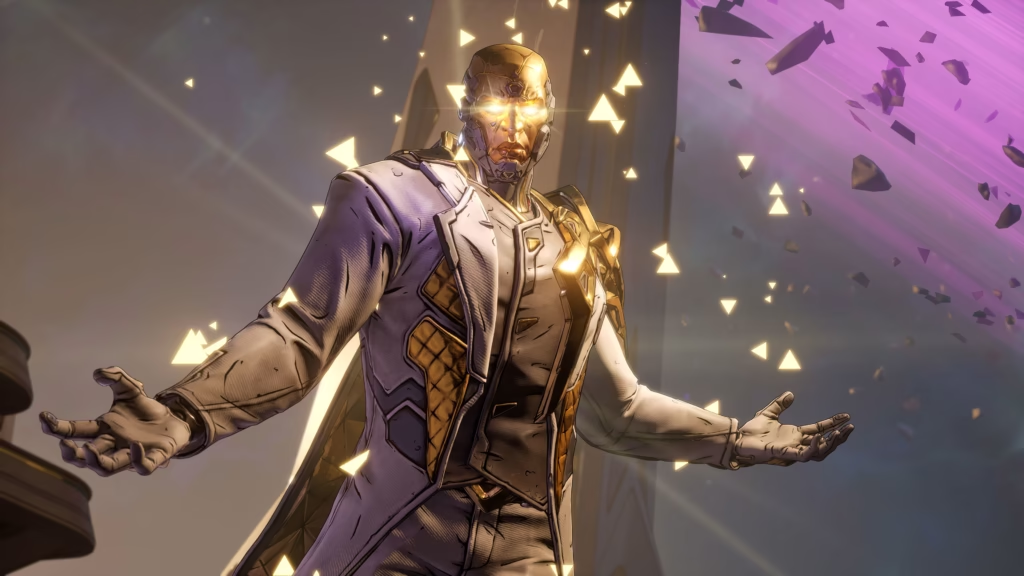
The Timekeeper (Villain of Borderlands 4) wants obedience. Eternal, unflinching, absolute.Control Bolts quite literally allow him to control individuals to either do his bidding or allow him to take personal control over them. They bleed into gameplay via the following:
- NPCs stop being eccentric, chaotic weirdos. They go monotone, robotic, unsettling
- Side missions lose spontaneity and become rigid
- Enemies stop acting like unhinged raiders and start behaving like programmed soldiers
- The world just feels tighter, smaller, more controlled
It’s like someone sanded the insanity of Pandora smooth.
Borderlands has always celebrated disorder. Suddenly, disorder feels fragile.
For a moment, the game asks you to imagine Pandora without its madness and it’s horrifyingly dull, grim and out of character. This is storytelling through mechanics. Further cementing it’s story telling the player why the Timekeeper must be stopped
And then… It’s gone, Barely seen throughout the game. One of the most thematically riveting mechanics Borderlands has shown is barely ever shown again.

No escalation, No moment where the bolts threaten your co-op buddy, No sequence where your skills get suppressed, No final stand where you fight to reclaim your agency. It’s as if the game makes a profound point then shrugs and goes back to loot fountains and jokes about exploding skags.
Borderlands thrives on chaotic unpredictability, sure. But here, it abandons a mechanic that could’ve elevated the narrative into legendary territory further supporting its story. It didn’t need a Last of Us identity crisis, Just follow-through.
It’s easy to forget under all the screaming guns and vending machine romance, but Borderlands has always threaded commentary through its mayhem:
- Hyper-capitalism parody through loot grind culture
- Hero worship and resistance movements twisted into something grotesque
- Friendship as an actual mechanic, not just a theme
The Control Bolt concept fits right into that lineage.It shows the franchise knows how to say something deeper, not instead of chaos, but through it. Which is why dropping it halfway hurts.
Because it proves the series can grow, then chooses not to. Borderlands doesn’t need to be serious all the time. But when it is, it’s surprisingly compelling and to have that dropped after the early game is insane. Part of what made this series so compelling are these concepts and villains at their strongest throughout the series- Think Handsome Jack, Angel, and plenty more figures. Without their constant inclusion the series interest and story would wane, just like how Borderlands 4 did.
Pandora is a place where freedom is dangerous, messy, exhausting, and worth fighting for. The Control Bolts dared to challenge that in a very creative way amongst Sirens, Capitalism and more. It demanded to be taken seriously. They made us feel the absence of chaos, not as relief, but as loss.
For a brief moment, Borderlands said: Freedom isn’t loud, Control is quiet, And quiet on Pandora is terrifying. That’s smart, That’s bold, And honestly, it deserved more screen time than a random side-quest psycho yelling about meat smoothies.
Borderlands doesn’t need to reinvent itself, it already knows how to be clever without losing its identity. The Control Bolts proved it. They showed us a version of the game where mechanics carry thematic weight, where chaos means something, and where oppression isn’t just villain flavor text, it’s a system you feel. Even if the idea got dropped like a white-rarity pistol, it left a mark. And maybe that’s the point: Chaos matters. Choice matters. Pandora is alive because it refuses to be controlled.